
Everything You're Looking at on a Smartphone Box — Decoded
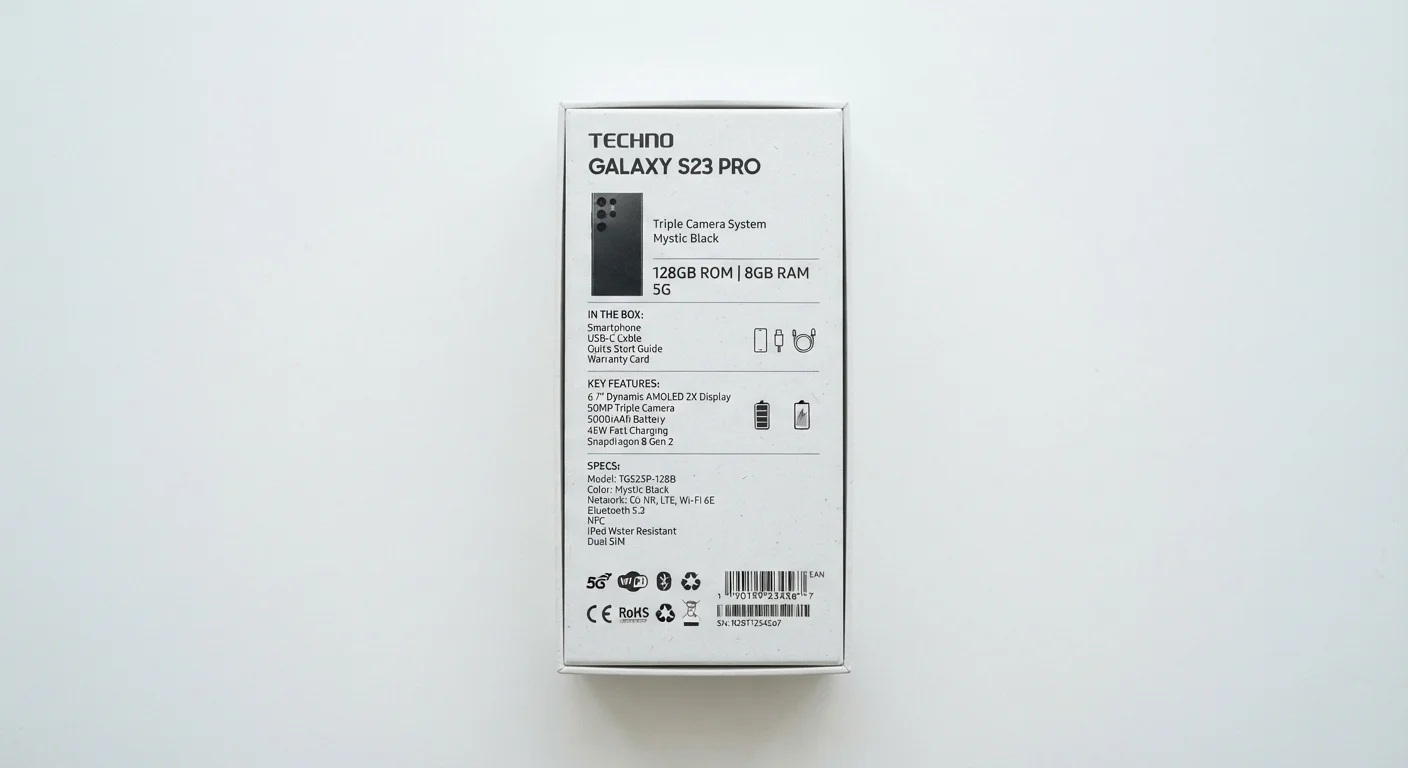
Photo credit: GadgetLite.net | All Things Tech
In this article
A quick-reference guide to every term printed on a phone's packaging, from SoC and eSIM to IP ratings and refresh rate.
What's Actually Printed on the Box
Smartphone packaging crams a surprising amount of information into a small space. Model name, storage size, network bands, camera resolution, battery capacity — most of it lands without explanation. This reference decodes every major term you'll encounter, so you know exactly what you're holding before the device ever powers on.
For a broader look at how these specs translate into real-world use, see what phone specs actually mean for the way you use your device. If you're also comparing laptops, PC spec sheet decoding follows the same logic in a different product category.
| SoC generations refreshed | Annually (major manufacturers) |
| IP68 lab submersion depth | 1.5 meters for 30 minutes (typical) (IEC 60529 standard) |
| Common flagship RAM range | 8 GB – 16 GB |
| Standard display refresh rates | 60Hz, 90Hz, 120Hz, 144Hz |
| eSIM adoption | Supported on most flagships since 2020 |
| Wi-Fi generations on current phones | Wi-Fi 6, 6E, and 7 |
The Core Specs, Line by Line
SoC (System on Chip): The processor, GPU, and cellular modem bundled into a single chip. It's the single biggest driver of speed, efficiency, and camera processing. A newer SoC generation generally means better performance and longer software support.
RAM: Short for Random Access Memory — the working memory that keeps apps running in the background. More RAM means smoother multitasking, though operating system efficiency matters just as much as raw numbers.
Storage (GB/TB): How much space the phone has for photos, apps, and files. Unlike RAM, this is permanent until you delete something. Many current flagships no longer include a microSD slot, so what's printed on the box is what you get.
Display resolution & refresh rate: Resolution (e.g., 1080p, 1440p) describes pixel density — higher means sharper text and images. Refresh rate, measured in Hz, controls how smoothly the screen updates. A 120Hz display scrolls and animates noticeably more fluidly than a 60Hz panel. See consumer electronics specs decoded for a deeper look at both.
Battery capacity (mAh): Milliampere-hours measure how much charge the battery holds. Higher mAh generally means longer life, but screen size, SoC efficiency, and software optimization all affect real-world endurance. For everything about charging speeds and long-term health, the complete picture on smartphone batteries covers it thoroughly.
IP Rating: Ingress Protection — a standardized two-digit code (e.g., IP68) indicating resistance to dust and water. The first digit rates dust protection (6 = fully dust-tight); the second rates water resistance (8 = submersible beyond 1 meter under controlled lab conditions). Real-world submersion isn't guaranteed to match lab results. The same rating system appears on wearables — reading a wearable spec sheet explains the nuances.
SoC (System on Chip)
A single chip that integrates the processor, graphics unit, and cellular modem. It's the primary determinant of a phone's speed, power efficiency, and AI capabilities.
IP Rating
A two-digit IEC standard code indicating resistance to dust and water. IP68, for example, means fully dust-tight and rated for submersion under controlled lab conditions — not an open warranty against water damage.
eSIM
An embedded SIM built into the device hardware. It allows carrier activation without a physical SIM card and often supports multiple profiles simultaneously.
Refresh Rate (Hz)
How many times per second the display redraws the image. Higher Hz values — 90Hz, 120Hz — produce smoother scrolling and animation at the cost of slightly more battery draw.
mAh (Milliampere-hour)
The unit used to express battery capacity. It represents how much electrical charge a battery can store; higher values generally indicate longer potential usage time.
HDR (High Dynamic Range)
A display and content standard that expands the range between the brightest highlights and darkest shadows. HDR10+, Dolby Vision, and HLG are different implementations of this standard.
mmWave
A high-frequency 5G band offering very fast peak data speeds in dense urban areas, but with short range and limited indoor penetration compared to Sub-6 GHz 5G.
Aperture (f-number)
A measure of how wide a camera lens opens to let in light. A lower f-number (e.g., f/1.8) means a wider opening, which improves low-light photography performance.
Connectivity and Camera Labels
5G / LTE / Sub-6 / mmWave: Network generation and frequency band indicators. 5G is the current standard; Sub-6 GHz offers broad coverage while mmWave (millimeter wave) delivers faster peak speeds in dense urban environments but with limited range. Check which bands your carrier supports — a 5G phone on an incompatible band defaults to LTE.
eSIM: An embedded SIM card built into the phone's hardware, eliminating the need for a physical nano-SIM tray. Many current phones support both a physical SIM and an eSIM simultaneously, enabling dual-number setups or easy carrier switching while traveling. For a full glossary of shorthand like this, the common glossary of smartphone terms is a useful companion.
Camera megapixels (MP): Measures the number of pixels a sensor captures per image. Higher MP enables larger prints and more cropping flexibility, but sensor size, aperture (f-number), and computational photography processing matter far more for low-light quality.
HDR / HDR10+ / Dolby Vision: Standards for high dynamic range — the range between the darkest and brightest parts of an image or video. Phones and streaming services need to support the same standard for the full benefit to apply.
Wi-Fi 6 / Wi-Fi 6E / Wi-Fi 7: Wireless network generations. Each newer generation offers higher theoretical speeds and better handling of congested environments (many devices on one router). Wi-Fi 6E and 7 also access the 6 GHz band, reducing interference at home.
For a complete tour of everything inside a flagship device — from lidar to satellite connectivity — everything packed into a modern flagship phone fills in the rest. And if you're thinking about how the phone's software layers fit into all of this, the software categories every device owner should know provides useful grounding.

Author
Releases Editorial Team
Releases Editorial Team is the collective byline for our editorial team and contributor network. Articles published under this byline or an editorial pen name are researched, written, and reviewed according to our editorial standards for clarity, consistency, and independence before publication.
View all articles →