
Everything Packed Into a Modern Flagship Phone, Explained Simply
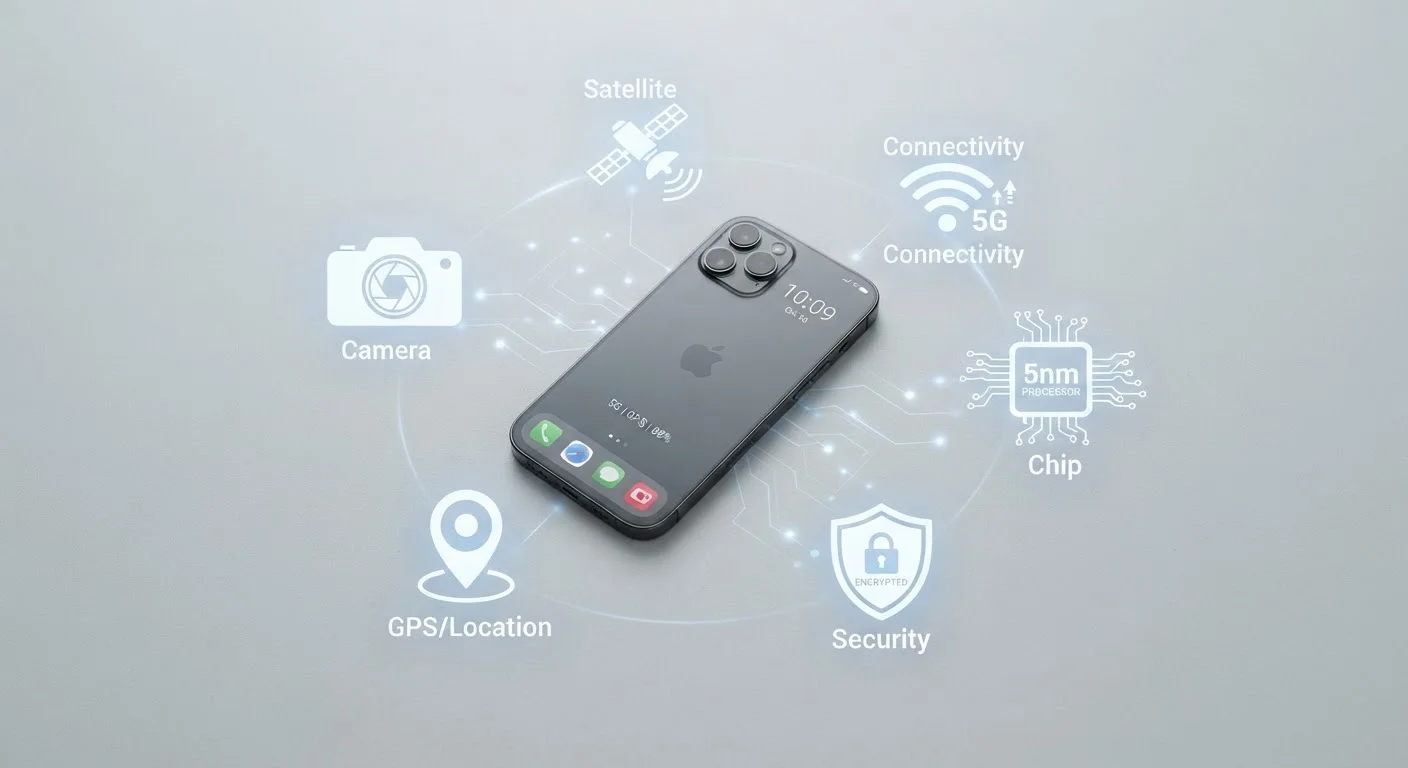
Photo credit: GadgetLite.net | All Things Tech
In this article
From lidar sensors to satellite connectivity — a plain-language tour of what today's high-end phones include and why it matters to real users.
Key Takeaways
- Flagship phones integrate a dedicated AI chip, advanced camera array, and satellite connectivity into a single device.
- Megapixel count is among the least meaningful camera specs — sensor size and computational processing matter far more.
- Satellite connectivity is a genuine safety feature, not a gimmick, usable in emergencies without cell coverage.
- A high refresh-rate display (120Hz) is noticeable daily; most users feel the difference within minutes.
- Many flagship features trickle down to mid-range phones within one to two product cycles.
- Understanding what each feature does in real life helps you decide whether the premium price is worth it for your habits.
What Makes a Phone a 'Flagship'
The word flagship simply means a manufacturer's highest-tier device — the model that carries their latest and most capable technology. Flagships aren't just expensive; they're engineering showcases where new components debut before eventually trickling down to cheaper phones. If you want a plain-English breakdown of the shorthand stamped on spec sheets, the smartphone glossary is a useful companion to this guide.
The key distinction is integration: a flagship phone doesn't just have a fast processor or a good camera — it's designed so that all its components work together. The chip handles camera processing. The camera informs the display's color output. The security hardware protects the AI model running on-device. That tight coordination is what you're paying for.
The Chip Inside: Why It Matters More Than Clock Speed
The SoC — system on a chip — is the brain of a modern phone. On flagships, this single piece of silicon contains the main processor, a graphics unit, a dedicated neural processing unit (NPU) for AI tasks, a modem for cellular connectivity, and image signal processors for photography. Treating it as just a "processor" misses most of what it does.
The NPU is where flagship chips pull furthest ahead of mid-range alternatives. It handles tasks like real-time photo enhancement, voice recognition, and on-device translation without sending data to the cloud — which is both faster and more private. Clock speed figures (measured in GHz) tell you very little about how snappy the phone feels day-to-day; it's the efficiency of the chip's architecture that determines real-world performance and battery life.
~40%
Performance gain from dedicated NPU vs. CPU for AI tasks
Industry benchmarks consistently show neural processing units completing on-device AI workloads significantly faster and more efficiently than general CPU cores.
120Hz
Refresh rate on most current flagship displays
High-refresh OLED panels have become a near-universal flagship standard, with adaptive versions that drop to lower rates to conserve battery when high speed isn't needed.
IP68
Water resistance rating on flagship phones
IP68 is the most common certification on flagship devices, indicating dust-tight protection and water resistance tested to at least 1.5 meters depth for 30 minutes.
Cameras: Beyond Megapixels
Modern flagship phones carry multiple rear cameras — typically a main wide lens, an ultrawide, and at least one telephoto — plus sophisticated front-facing cameras. Megapixels measure resolution, but sensor size, aperture (how much light enters), and the image signal processor together determine photo quality far more meaningfully. A larger sensor gathers more light, which is why flagship night photography looks dramatically different from budget-phone results.
Lidar scanners (found on some high-end models) use laser pulses to map depth in a scene. In practical terms this speeds up autofocus in low light and makes augmented-reality applications more accurate. Periscope telephoto lenses use an internal mirror to achieve optical zoom — physically enlarging the subject — rather than digital zoom, which is essentially just cropping.
When comparing camera systems, prioritize the aperture and sensor size of the main wide lens — that's the camera you'll use in 80% of situations, especially indoors and at night.
The main sensor handles the widest variety of lighting conditions; ultra-wide and telephoto lenses are supplementary tools that matter more in specific scenarios like landscapes or distant subjects.
Ignore manufacturer zoom claims like '10x Space Zoom' and focus on optical zoom range — anything beyond optical zoom is digital cropping, which any phone can do in software.
Optical zoom uses glass to physically magnify a scene before it hits the sensor; digital zoom enlarges pixels after the fact, producing softer, noisier results at high magnification.
For a deeper look at what spec numbers actually translate to in use, see what the spec sheet won't tell you.
Connectivity: 5G, Satellite, and Wi-Fi 7
Flagship phones now ship with several overlapping connectivity technologies, each solving a different problem.
- 5G delivers faster cellular data where carriers have deployed compatible infrastructure. Sub-6GHz 5G offers wide coverage and modest speed gains over 4G LTE; mmWave 5G (millimeter wave) is significantly faster but has limited range and building penetration, so it's mostly relevant in dense urban areas.
- Satellite connectivity lets the phone send short emergency messages or share your location via satellite when no cell signal exists. It isn't a replacement for regular service, but it's a genuine safety tool for hiking, road trips, or natural disasters.
- Wi-Fi 7 (802.11be) reduces latency and increases throughput on compatible home routers. For most users streaming video or browsing, the difference over Wi-Fi 6 is modest — it matters more for low-latency use cases like cloud gaming.
Satellite Connectivity Has Real Limits
Emergency satellite messaging on current phones is designed for distress situations — sending your location or a short text when no cell tower is reachable. It is not a substitute for a cellular plan and cannot currently support voice calls or general data. Response times through satellite links can also be significantly slower than cellular. Always treat it as a safety backup, not a connectivity solution.
Display, Battery, and Durability
Flagship displays typically use OLED panels with refresh rates of 120Hz or higher. Refresh rate describes how many times per second the screen redraws — 120Hz makes scrolling and animations visually smoother compared to the 60Hz standard on budget phones. Most users notice the difference immediately when switching.
Peak brightness (measured in nits) determines outdoor legibility. A display rated above 2,000 nits remains readable in direct sunlight; lower-tier screens can become almost unusable outdoors on a bright day.
On durability: IP68 water resistance means the phone can survive submersion in up to 1.5 meters of fresh water for 30 minutes under controlled test conditions — real-world protection in rain or accidental splashes is reliable, but sustained underwater use is not guaranteed. Gorilla Glass or similar ceramic-based screen protection reduces scratch risk but doesn't eliminate it.
Protect Your Screen From Day One
Even Gorilla Glass flagship screens scratch from everyday grit in pockets and bags. A tempered-glass screen protector applied on day one costs very little and prevents the fine surface scratches that accumulate quickly. Cases with raised edges around the camera bump also prevent lens scratches, which are harder to notice but affect photo quality over time.
Security and AI Features Built Into the Hardware
Modern flagships include a dedicated secure enclave — isolated hardware storage for biometric data, payment credentials, and encryption keys. This means your fingerprint or face data never leaves the chip in a readable form, even if the phone's operating system is compromised.
On-device AI runs increasingly complex tasks locally: generating image captions, summarizing notifications, translating live conversations, and removing objects from photos. Because this processing happens on the NPU rather than a remote server, results are faster and data stays on your device. Built-in accessibility features also rely heavily on this local AI capability — live captions, real-time transcription, and sound recognition all draw on the same hardware.
“The most meaningful shift in smartphone hardware over the past few years isn't raw processing speed — it's the move toward running complex tasks entirely on-device, without a round trip to the cloud. That changes what's possible for privacy and responsiveness.”
— Mobile Hardware Researcher, Consumer Electronics Industry Analyst
Do You Actually Need All of This?
Honest answer: it depends entirely on how you use your phone. If photography, privacy, or outdoor reliability are priorities, flagship hardware delivers real advantages. If you primarily browse, message, and stream video, a well-made mid-range phone covers those tasks almost identically — and mid-range phones outperform flagships for many everyday users in value terms.
The useful framework isn't "is the flagship better?" — it usually is in measurable ways — but "is it better in ways that matter to my daily habits?" For a side-by-side look at where the tiers genuinely diverge, the real differences between phone tiers lays out an honest breakdown. Understanding what each component does is the first step toward making a purchase decision you won't regret.
Smartphone Glossary: Every Term Decoded
A plain-English reference for spec sheet shorthand — SoC, IP68, eSIM, HDR10+, and more — so you can read any phone listing with confidence.
Flagship vs. Mid-Range: Real Differences
An honest breakdown of what you actually gain moving from a mid-range phone to a flagship, and where the gap is smaller than marketing suggests.
Smartphone Box Decoder
Every term printed on a phone's packaging explained, from refresh rate and SoC to eSIM and IP ratings — useful before or after purchase.

Author
Gadgets Editorial Team
Gadgets Editorial Team is the collective byline for our editorial team and contributor network. Articles published under this byline or an editorial pen name are researched, written, and reviewed according to our editorial standards for clarity, consistency, and independence before publication.
View all articles →