
Console, PC, or Mobile: What Actually Separates the Three Gaming Worlds
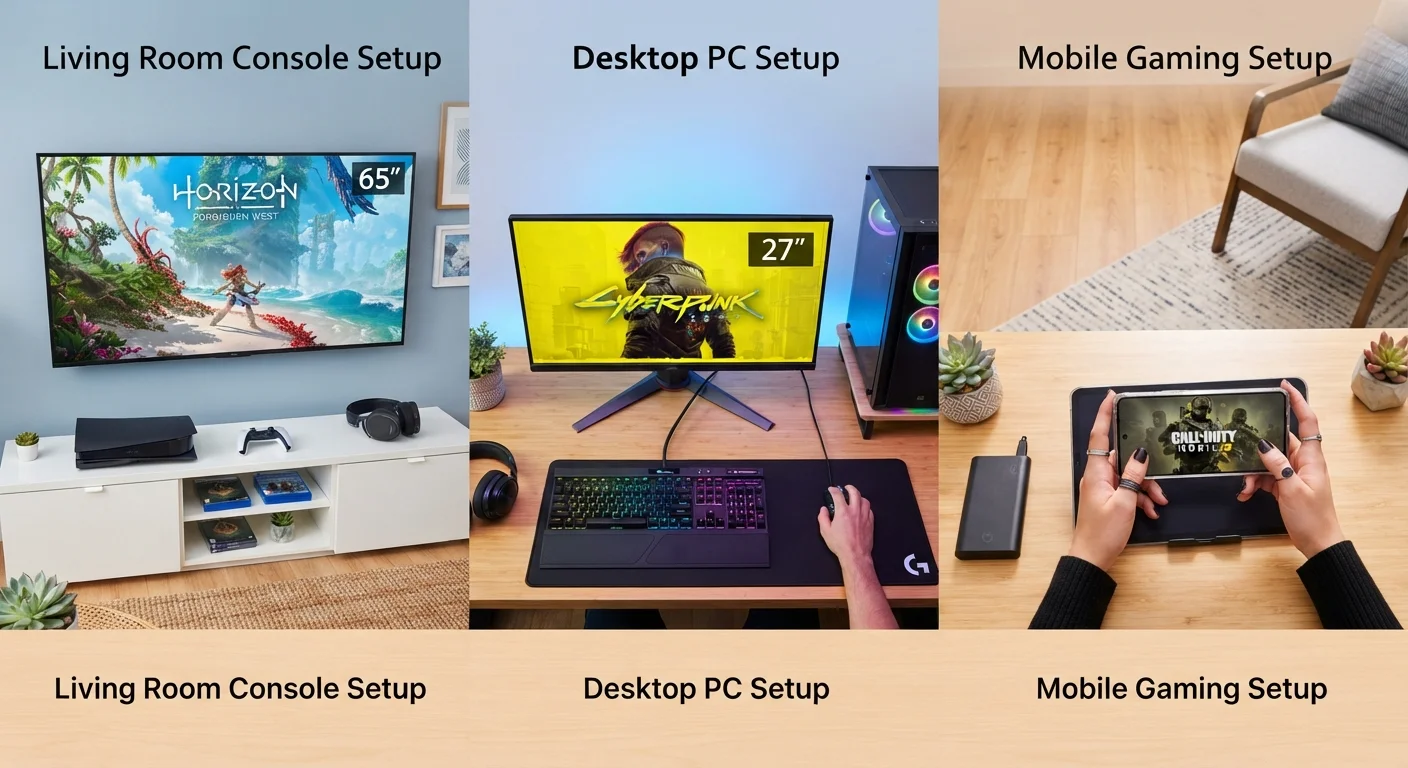
Photo credit: GadgetLite.net | All Things Tech
In this article
A clear breakdown of how consoles, PCs, and mobile devices differ as gaming platforms — hardware, libraries, costs, and experience.
Key Takeaways
- Consoles are purpose-built for gaming and prioritize simplicity and living-room convenience.
- PCs offer the most hardware flexibility but require more setup knowledge and upfront cost.
- Mobile gaming reaches the largest global audience, primarily through touchscreen free-to-play titles.
- Each platform has exclusive games that cannot legally be played on the others.
- Your ideal platform depends on how, where, and with whom you like to play.
What Makes Each Platform Distinct
At the most basic level, the three gaming worlds are separated by hardware purpose, software ecosystems, and the experience they're designed to deliver. Understanding those three pillars makes everything else click into place.
Consoles — like PlayStation, Xbox, and Nintendo Switch — exist purely for entertainment. You plug them in, insert or download a game, and play. There's no configuring drivers or upgrading components. That simplicity is the entire point.
PCs are general-purpose machines that also happen to be powerful gaming devices. Because the hardware isn't fixed, PC gaming offers a wide range of performance tiers and the ability to upgrade over time. That flexibility comes with more complexity — installing games, managing settings, and occasionally troubleshooting.
Mobile — smartphones and tablets — is the youngest major gaming platform but by far the largest by active player count. The games are primarily touchscreen-driven and distributed through app stores. The device is already in your pocket, which makes the barrier to entry essentially zero.
Platforms Can Overlap More Than You Think
Some games are available on all three platforms simultaneously, and features like cross-play allow players on different systems to compete or cooperate online. The walls between gaming worlds aren't as absolute as platform marketing often implies. Smartphone hardware has also evolved rapidly, narrowing the performance gap with dedicated gaming devices in some contexts.
Game Libraries and Exclusives
One of the most practical differences between platforms is what you can actually play. Each platform has its own storefront and its own exclusive titles — games that only run on that system.
Console exclusives are a major competitive tool: certain flagship franchises are tied to specific hardware families and won't appear on rival platforms. PC gaming draws from several storefronts and hosts a massive back-catalog of titles, including many older games that never made it to modern consoles. Mobile game stores carry millions of titles, though the dominant model leans toward free-to-play games with optional in-app purchases rather than one-time purchases.
Cross-platform releases — games available on multiple systems simultaneously — are increasingly common, especially for multiplayer-focused titles. But exclusivity still shapes buying decisions significantly.
3B+
Estimated global mobile gamers
Mobile gaming is widely cited as the largest gaming segment by player count, with estimates from industry analysts consistently exceeding three billion active players worldwide.
~50%
Share of global game revenue from mobile
Mobile gaming accounts for roughly half of global games industry revenue, according to market research firms tracking the games sector.
Millions
Titles available on PC storefronts
PC gaming platforms collectively host far more titles than any single console storefront, including large back-catalogs of classic and independent games.
If your favorite genres matter most, check which platform hosts the strongest library for them. Understanding gaming genres can help you figure out what to look for.
Controls, Cost, and Where You Play
How you physically interact with a game varies dramatically by platform. Consoles use standardized controllers — thumbsticks, triggers, face buttons — designed to feel comfortable on a couch. PCs support both keyboard-and-mouse (which offers precision advantages in many game types) and controllers. Mobile relies on touchscreen inputs, which work beautifully for some game designs and feel awkward in others. Input method matters more than most newcomers realize.
Try Before You Commit
Many mobile games are free to download and try. PC storefronts sometimes offer refund windows after a short play period. Console manufacturers occasionally offer game trial subscriptions. Exploring these options before a major hardware purchase can save a lot of regret.
Cost structures also differ. Consoles have a fixed upfront hardware cost with relatively predictable game pricing. PC hardware spans an enormous price range depending on the components you choose — keeping up with new PC releases can help you understand what hardware tiers exist. Mobile devices are devices people already own for other reasons, so the marginal gaming cost is low — though in-app purchases can add up quickly.
Finally, where you play matters. Consoles anchor you to a TV, though portable options like handheld hybrid devices blur that line. PCs are desk-bound unless you're using a gaming laptop. Mobile wins on portability by definition. For a deeper look at how console and PC gaming stack up on these factors, this side-by-side comparison covers the key differences.
The Right Platform Is the One That Fits Your Life
There's genuinely no universal winner among the three platforms — each one solves a different problem. Consoles deliver a reliable, social, living-room gaming experience without technical fuss. PCs provide maximum flexibility and a deep game catalog for players willing to engage with the hardware. Mobile meets you where you already are, making gaming available in commutes, waiting rooms, and casual moments.
Many players end up using more than one. Someone might own a console for big-screen multiplayer sessions and use a smartphone for games during a commute. Platforms aren't mutually exclusive, and your mix can shift as your habits change.
It's also worth knowing that a fourth option — cloud gaming — streams games over the internet without dedicated hardware, though it comes with its own trade-offs around internet requirements and latency.
If you've heard sweeping claims about any of these platforms — that PC gaming is always expensive, or that mobile isn't a real gaming platform — it's worth separating the myths from the reality before making a decision.
Frequently Asked Questions

Author
Gaming Editorial Team
Gaming Editorial Team is the collective byline for our editorial team and contributor network. Articles published under this byline or an editorial pen name are researched, written, and reviewed according to our editorial standards for clarity, consistency, and independence before publication.
View all articles →