
Reading a Wearable Spec Sheet Without Getting Lost
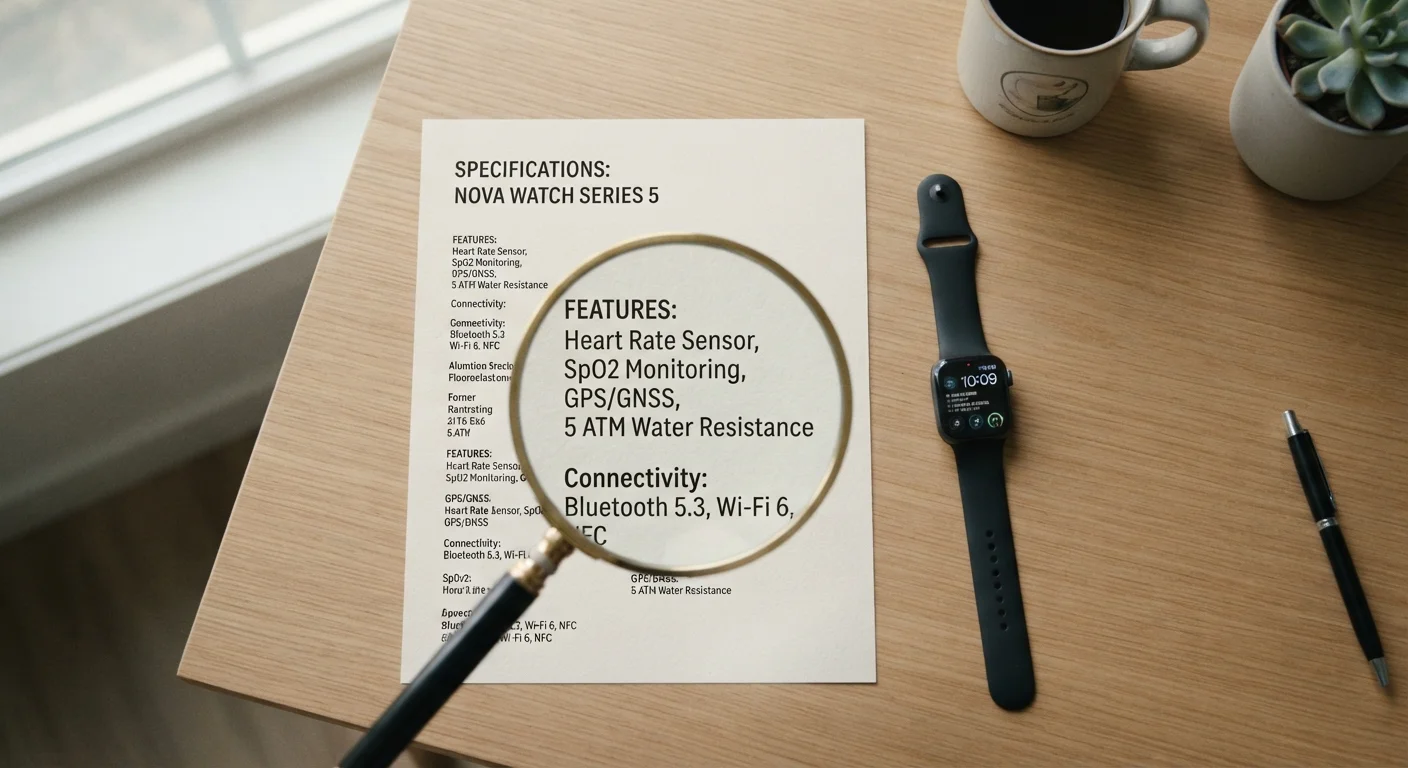
Photo credit: GadgetLite.net | All Things Tech
In this article
Battery life, IP ratings, refresh rates—wearable spec sheets are full of jargon. This reference breaks down every term you'll actually encounter.
Why Spec Sheets Feel Like a Foreign Language
Wearable spec sheets are written for databases, not humans. Manufacturers list every measurable attribute — display resolution, sensor count, IP rating — with minimal explanation, assuming the reader either already knows the terminology or will simply trust the marketing headline. Neither is a great outcome for someone trying to decide if a $350 smartwatch is worth the purchase.
The good news: most wearable specs fall into a handful of categories, and once you've decoded them once, you'll recognize them everywhere. This reference covers the terms that appear most often, grouped by what they actually affect in day-to-day use. For a broader orientation to the wearable landscape, see The Everyday Person's Introduction to Wearable Tech.
| Most common water resistance rating | IP68 (Standard on most mid-to-high-end wearables) |
| Typical smartwatch battery life (box claim) | 1–14 days depending on model (Manufacturer lab conditions; real-world figures are lower) |
| Common Bluetooth version on current wearables | Bluetooth 5.0–5.3 (Improves range and energy efficiency over older versions) |
| Standard display refresh rate | 60Hz (standard) / up to 60–120Hz (premium) (Higher rates improve smoothness; drain battery faster) |
| LTE availability | Optional on smartwatches; absent on most bands and rings (Requires a compatible carrier plan) |
| Sensors found on most mid-range wearables | Heart rate, SpO2, accelerometer, gyroscope (ECG and skin temp typically limited to premium tier) |
The Core Specs and What They Mean
Display specs include resolution (measured in pixels), pixel density (pixels per inch, or PPI — higher means sharper text), and refresh rate (how many times per second the screen redraws, measured in Hz). A higher refresh rate produces smoother scrolling but uses more battery. Always-on display (AOD) modes keep basic info visible without a wrist raise, at a battery cost.
Battery life figures quoted on the box are almost always measured under controlled, light-usage conditions — GPS off, notifications minimal, screen brightness low. Real-world use with GPS tracking, frequent notifications, or an always-on display will produce a shorter result. Wearable Battery Life: What the Numbers on the Box Don't Tell You breaks this down in detail.
IP and MIL-SPEC ratings define water and dust resistance. An IP68 rating, for example, means the device is dust-tight and can withstand submersion in fresh water beyond 1 meter — though exact depth and duration vary by manufacturer. MIL-STD-810 refers to a U.S. military durability testing standard covering shock, vibration, and temperature extremes. Neither rating guarantees survival in every real-world scenario.
IP Rating
Ingress Protection rating — a two-digit code indicating resistance to dust (first digit) and water (second digit). Higher numbers mean greater protection. IP68 is the most common rating on premium wearables.
SpO2
Blood oxygen saturation measurement. Wearable SpO2 sensors use optical light to estimate the percentage of oxygen in your blood. Results are approximate, not medical-grade, unless the device carries specific regulatory clearance.
Always-On Display (AOD)
A display mode that keeps basic information — time, step count, heart rate — visible continuously without requiring a wrist raise or button press. Convenient, but increases battery drain compared to a standard wake-on-raise mode.
NFC
Near Field Communication — a short-range wireless technology (typically a few centimeters) used for tap-to-pay transactions and quick device pairing. Not all wearables include NFC.
LTE
A cellular radio standard that allows a wearable to connect to mobile networks independently of a paired smartphone. Devices with LTE can receive calls, messages, and data without a phone nearby.
Codec
A compression format for audio transmitted over Bluetooth. Common codecs include SBC (standard), AAC (common on Apple devices), aptX, and LDAC. Higher-quality codecs can deliver better audio fidelity, provided both devices support them.
MIL-STD-810
A U.S. military durability testing standard that covers resistance to shock, vibration, altitude, humidity, and temperature extremes. Manufacturers self-certify compliance; testing conditions vary.
Refresh Rate
How many times per second a display redraws its image, measured in Hertz (Hz). A 60Hz display redraws 60 times per second; 60Hz is standard, while 60–120Hz is common on newer devices. Higher rates mean smoother animations at a battery cost.
Sensors are listed as a feature inventory but vary widely in quality. An optical heart rate sensor, SpO2 monitor (blood oxygen estimation), and accelerometer are common across most mid-range wearables. ECG (electrocardiogram) and skin temperature sensors appear on higher-end devices. Sensor presence doesn't guarantee medical-grade accuracy — check whether the device has regulatory clearance if that matters to your use case.
Connectivity terms include Bluetooth version (affects range and energy efficiency), Wi-Fi band support (2.4GHz vs. 5GHz), LTE (a cellular radio that lets the device work independently of a paired phone), and NFC (short-range communication used for tap-to-pay). Not every wearable includes all of these. For a full term-by-term breakdown, The Wearable Glossary is a useful companion reference.
Specs That Matter Most by Device Type
Not every spec matters equally for every wearable category. The Complete Picture of Wearable Device Categories covers what each type of device does — which helps you know which specs to weight more heavily.
- Smartwatches: Battery life, display type, health sensors, and LTE availability tend to matter most.
- Fitness bands: Battery life dominates; display quality is secondary. GPS accuracy matters for runners and cyclists.
- Smart rings: Battery life, form factor (size range available), and sensor suite are the key differentiators. No display means almost no display-related trade-offs.
- Earbuds with health features: Codec support (SBC, AAC, aptX, LDAC — these affect audio quality over Bluetooth), active noise cancellation (ANC) depth, and latency (the delay between audio source and playback, important for video) are the specs to read carefully.
Self-Certified Durability Claims Vary
MIL-STD-810 compliance is self-tested by manufacturers — there is no third-party certification body that must approve the claim. Different brands may test different subsets of the standard's requirements. Treat durability ratings as a general indicator of build quality, not a warranty against damage in specific scenarios.
If you want to see how spec-reading translates to another device category, PC Releases Decoded applies the same approach to laptop announcements.

Author
Releases Editorial Team
Releases Editorial Team is the collective byline for our editorial team and contributor network. Articles published under this byline or an editorial pen name are researched, written, and reviewed according to our editorial standards for clarity, consistency, and independence before publication.
View all articles →