
Tech Accessories That Genuinely Earn Their Space in a Bag
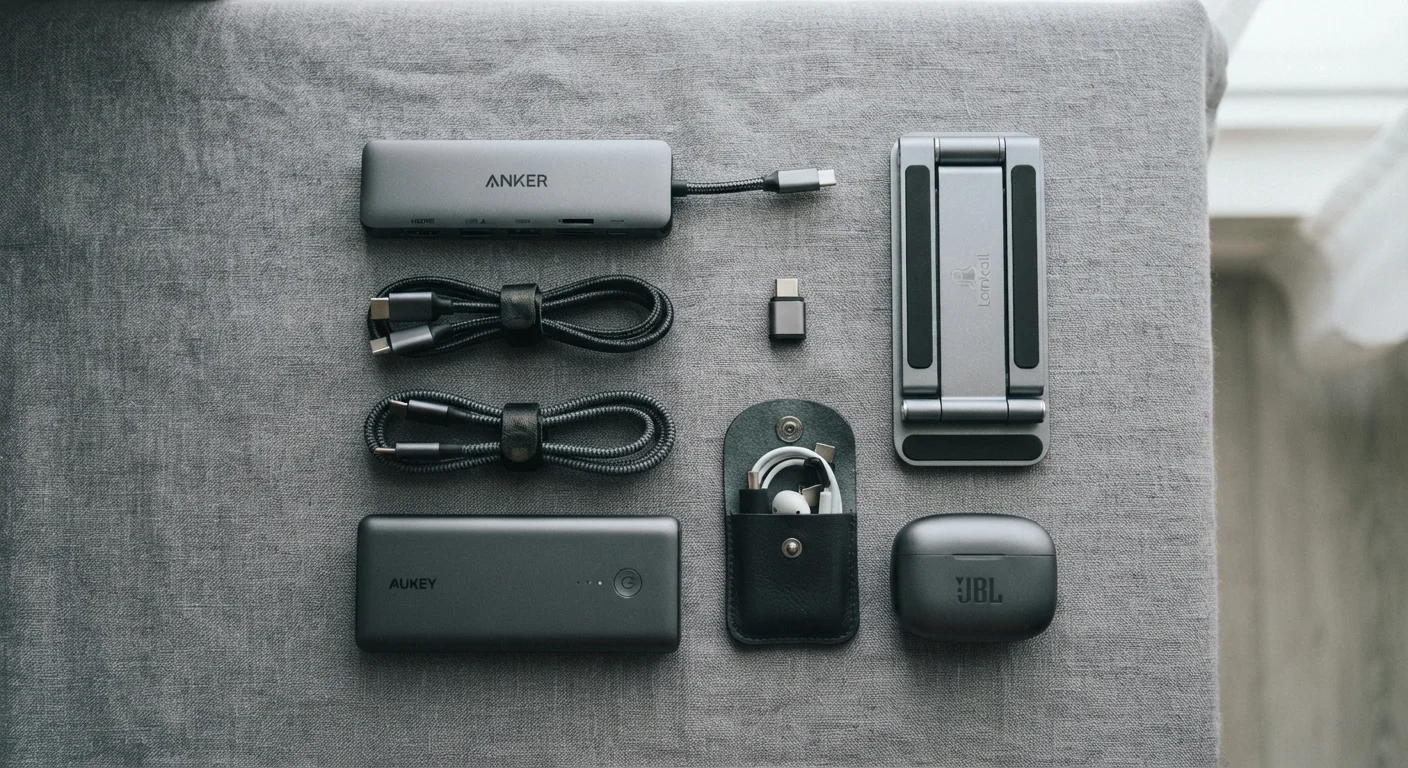
Photo credit: GadgetLite.net | All Things Tech
In this article
A curated look at everyday carry accessories — cables, adapters, stands, and more — that solve real problems rather than just looking good.
Key Takeaways
- The best carry accessories solve a recurring problem rather than adding weight for occasional use.
- Multi-port USB-C hubs often replace three or four single-purpose adapters in one compact package.
- A braided, short-length cable is more practical for daily carry than a longer standard cable.
- Portable battery packs earn their place only when sized to your real power needs, not marketed maximums.
- Foldable stands improve posture and video call quality enough to justify space in most bags.
- A few well-chosen accessories consistently outperform a bag full of rarely used gadgets.
Why Most Carry Accessories Don't Earn Their Keep
Walk into any tech retailer — or scroll through an online marketplace — and you'll find hundreds of accessories positioned as everyday essentials. The reality is that most of them solve problems you don't have, or solve real problems in ways that are too bulky, too fragile, or too narrow in scope to justify the bag space they consume.
The accessories that genuinely earn their place share a common trait: they reduce friction in situations you encounter regularly. That might mean expanding your laptop's connectivity on the road, preventing a dead phone during a long commute, or simply keeping cables from turning your bag into a tangled mess. When an accessory addresses something you've actually cursed at in the past week, it belongs. Everything else is clutter.
For a complementary perspective on which built-in ports matter most before you even start adding accessories, see our guide to practical laptop ports. Understanding what your device already offers helps you avoid duplicating it in your bag.
A compact multi-port USB-C hub
Modern laptops — particularly thin and light models — often ship with just one or two USB-C ports. A compact hub that adds USB-A ports, an HDMI output, and an SD card slot consolidates what used to require three separate adapters. Look for passthrough charging support so the hub itself doesn't consume your only charging port while in use.
Size matters here. A hub that's too large defeats the purpose. Pocket-sized models that weigh under three ounces are practical; desk-sized docks are better left at a fixed workstation.
One compact hub can quietly retire three or four single-purpose adapters you've been carrying separately.
A short, braided charging cable
Standard 6-foot cables are designed for nightstand use, not bags. A braided 1-to-2-foot cable is easier to coil, resists fraying far longer than rubber-sheathed alternatives, and takes up roughly a third of the space. If you regularly charge from a laptop port, a power bank, or a café table, a short cable reduces the tangle penalty considerably.
Braided nylon or Kevlar-wrapped options tend to outlast standard cables by a meaningful margin under daily mechanical stress — bending, pulling, and re-coiling day after day.
A short braided cable is more durable, more packable, and more practical than a long standard one.
A realistically sized portable battery pack
Battery packs are among the most over-bought accessories in the category. A 20,000 mAh pack sounds impressive, but it often weighs over a pound and exceeds airline carry-on limits for lithium cells in some configurations. For most users, a 10,000 mAh pack — enough to fully recharge the average smartphone two to three times — hits the practical sweet spot between capacity and portability.
Prioritize packs that support USB Power Delivery (USB-PD), a standard that enables faster charging for compatible phones and laptops. Marketing numbers for charge times are often measured under ideal lab conditions; real-world results vary.
The right battery pack size is the one you'll actually carry every day, not the one with the biggest number.
A foldable phone or tablet stand
A stand changes how you interact with your device during video calls, while following a recipe, or when using your phone as a second screen alongside a laptop. Foldable aluminum or polycarbonate stands collapse flat and weigh almost nothing. The ergonomic benefit — keeping screens at eye level rather than neck-craning down at a flat surface — is immediate and cumulative.
This is an accessory that pays off differently depending on how you work. Remote workers who take calls from varied locations tend to notice the benefit most acutely, but even casual use cases like reading or streaming improve with a stable, hands-free setup.
A foldable stand costs little space but meaningfully changes how comfortable screen use feels throughout the day.
A small cable organizer or pouch
Cables, adapters, and earbuds don't have a tangle problem — bags do. A small zippered organizer or roll pouch with elastic loops keeps accessories sorted, prevents cables from coiling into useless knots, and makes the entire kit faster to access. It also protects connectors from the abrasion of loose items rattling around.
This is one of the lowest-cost, highest-impact items in any carry kit. A well-organized pouch also makes it easier to audit what you're carrying — if something never leaves the pouch, it probably doesn't need to be there.
Organization is its own accessory — a small pouch turns a tangled kit into one you'll actually use.
Compact wireless earbuds (with a real case)
Earbuds earn their place not just for audio but for focus, calls, and noise management in unpredictable environments. The case matters as much as the buds: a case that charges the earbuds between uses doubles or triples effective listening time without requiring a wall outlet. Cases that add two to three full charges are a practical baseline.
Fit and passive noise isolation — how well the bud physically blocks ambient sound — vary significantly between models and ear shapes. If possible, test fit before committing. An earbud that falls out every 20 minutes loses its value regardless of audio quality.
A charging case that extends earbud life several times over is what separates truly portable audio from a fragile novelty.
Building a Bag Kit That Actually Works
The goal isn't to cover every scenario — it's to cover the scenarios you actually encounter. Start by auditing the last two weeks: what did you scramble to find, improvise around, or wish you had? That friction list is a more honest buying guide than any spec comparison.
Audit before you add
Before purchasing a new accessory, carry your current kit for a full week and note which items you actually reach for. Anything untouched at the end of the week is a candidate for removal, not a reason to add more. A lighter, more deliberate kit is almost always more useful than a comprehensive one.
Accessories designed for one device category often cross over usefully. A USB-C hub bought for a laptop frequently works just as well with a tablet or phone in a pinch. Versatility compounds value. The same principle applies beyond the bag — our room-by-room home tech guide shows how multi-use thinking plays out across everyday living spaces.
Accessories also interact with habits. An excellent portable charger sitting forgotten at the bottom of a drawer does nothing. If you're looking at how consistent routines keep technology actually useful, our piece on keeping wearable tech useful long-term applies the same logic to devices you wear daily.

Author
Gadgets Editorial Team
Gadgets Editorial Team is the collective byline for our editorial team and contributor network. Articles published under this byline or an editorial pen name are researched, written, and reviewed according to our editorial standards for clarity, consistency, and independence before publication.
View all articles →