
Wearable Devices: The Full Story From Sensors to Ecosystems
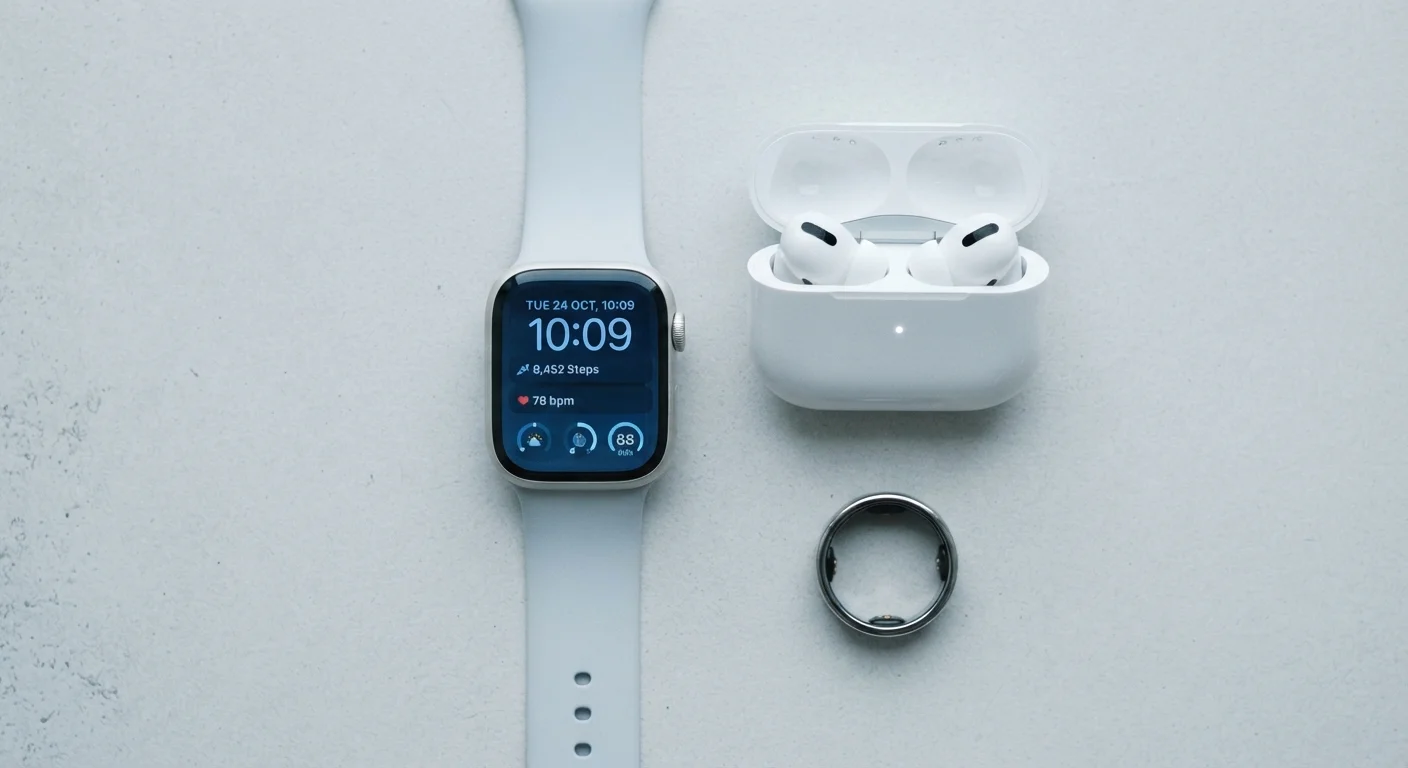
Photo credit: GadgetLite.net | All Things Tech
In this article
An end-to-end guide to wearable tech — how the hardware works, what the software does, and how it all connects to your digital life.
Key Takeaways
- Wearables rely on multiple specialized sensors working together to generate health and activity data.
- On-device software and companion apps translate raw sensor readings into meaningful, actionable insights.
- Bluetooth, Wi-Fi, and cellular connectivity determine how and when data syncs to your other devices.
- Battery life is shaped by screen brightness, sensor polling frequency, and wireless radio usage.
- Your wearable data is often shared with cloud platforms — understanding privacy settings matters.
- Ecosystem compatibility — not just specs — should guide which wearable you choose.
What Makes a Wearable Tick: The Sensor Layer
Every wearable device — whether a smartwatch, fitness band, or smart ring — is fundamentally a collection of miniaturized sensors wrapped in a wearable form factor. Understanding what those sensors do is the first step to understanding what your device can and cannot tell you.
The most common sensor found in wearables is the optical heart rate monitor, which uses photoplethysmography (PPG) — a method that shines green LED light into the skin and measures how much is absorbed by blood flow. This same optical hardware, when augmented with additional wavelengths and algorithms, underpins blood oxygen (SpO2) estimation features found in many modern devices.
Motion is tracked by an accelerometer (detecting linear movement) and a gyroscope (detecting rotation and orientation). Together they enable step counting, sleep stage detection, fall detection, and gesture recognition. Higher-end devices add a barometric altimeter to detect elevation changes — useful for stair climbing counts and outdoor altitude tracking.
~10+
Distinct sensors in a typical smartwatch
Modern smartwatches commonly integrate sensors for heart rate, SpO2, motion, temperature, altitude, and ECG in a single device.
1–14 days
Typical smartwatch battery range
Battery endurance varies widely depending on display type, sensor usage frequency, and connectivity features enabled.
~1 MHz
PPG sampling rate in many wearables
Optical heart rate sensors sample reflected light at high frequencies to construct an accurate waveform for analysis algorithms.
Skin temperature sensors, electrodermal activity sensors, and even rudimentary electrocardiogram (ECG) electrodes have become increasingly common. These expand what a wearable can monitor, but it's worth noting that consumer-grade sensors are optimized for wellness tracking, not clinical diagnosis. For a broader look at how sensing technology appears across the device landscape, see our guide to modern consumer electronics.
From Raw Data to Readable Insights: The Software Stack
Raw sensor output is just noise without software to interpret it. Wearables run a layered software stack: a real-time operating system (RTOS) or a stripped-down variant of a mobile OS handles sensor sampling, while dedicated signal-processing algorithms convert electrical signals into numbers your app can display.
Manufacturers invest heavily in proprietary algorithms — the logic that translates an irregular PPG waveform into a heart rate reading, or a series of accelerometer vectors into a recognized sleep stage. These algorithms are continuously refined through firmware updates, which is one reason a wearable can become meaningfully more capable after purchase without any hardware change.
Check the firmware update history of a wearable before purchasing — a platform that ships regular algorithm updates effectively improves the device you already own without new hardware.
Signal-processing improvements and new health features are routinely delivered via software, meaning update cadence is a reliable proxy for long-term device value.
When comparing health tracking accuracy across devices, look for independent third-party validation studies rather than relying solely on manufacturer claims.
Consumer wearable sensors vary significantly in accuracy, particularly for SpO2 and ECG readings, and independent testing reveals performance gaps that spec sheets won't.
Companion smartphone apps serve as the primary interface for historical trends, goal setting, and deeper analysis. Many platforms now layer machine learning models on top of aggregated user data to surface patterns — flagging anomalies or predicting recovery needs. This processing increasingly happens both on-device (for privacy and speed) and in the cloud (for model accuracy at scale).
For a plain-language breakdown of what various wearable categories actually do day to day, Wearable Tech Explained provides a helpful companion read.
Connectivity: How Wearables Plug Into Your Digital Life
Most wearables connect primarily via Bluetooth Low Energy (BLE), a protocol designed for short-range, battery-efficient data transfer. BLE handles the continuous sync between your wrist and your phone — pushing notifications, syncing workout data, and relaying commands. Its low-power profile is why a watch can maintain a Bluetooth connection throughout the day without dramatically impacting battery life.
Wi-Fi enables faster bulk data transfers — syncing a week of sleep data or downloading a firmware update — without needing a phone nearby. Cellular-capable wearables go further, allowing independent calls, messages, and data access when your phone is out of range, though this adds cost and power consumption.
Match Your Radio Set to Your Use Case
If you primarily run with your phone, built-in GPS may be less critical than long battery life. If you want to leave your phone at home during workouts, prioritize devices with onboard GPS and cellular. Auditing which radios you'll actually use helps narrow your options quickly.
NFC (near-field communication) powers contactless payments and quick device pairing. GPS — either built-in or phone-assisted — enables accurate outdoor route tracking. The combination of radios a device carries directly affects its feature set, size, and battery life, making connectivity specs one of the most important things to cross-check before choosing a device. Explore the broader landscape of smart wearables and accessories at our Wearables & Accessories hub.
Battery Life and Power Management
Battery life is one of the most discussed — and most misunderstood — wearable specs. Manufacturers typically quote figures under controlled conditions: specific screen brightness, sensor polling intervals, and minimal wireless activity. Real-world usage almost always falls short of headline numbers.
The main battery drains are: always-on display mode, continuous GPS tracking, frequent heart rate sampling, and cellular connectivity. Disabling or reducing any of these can extend runtime significantly. Many devices offer a dedicated low-power or battery-saver mode that disables non-essential features to stretch endurance for multi-day trips or specific use cases.
Battery Degradation Is Inevitable
Lithium-ion batteries in wearables lose charge capacity over time — typically retaining around 80% of original capacity after 300–500 full charge cycles, though actual degradation depends on usage habits and charging temperature. If long-term ownership is important to you, check whether the manufacturer offers a battery replacement program for the device you're considering.
Wearable batteries are small by necessity — typically between 200 mAh and 500 mAh for most smartwatches — and they degrade over charge cycles like any lithium-ion cell. Understanding this trade-off between thinness, features, and endurance helps set realistic expectations.
Privacy and Data: What You Should Know
Wearables generate an unusually intimate category of data — heart rhythms, sleep patterns, movement, location history, and in some cases menstrual cycle tracking or stress indicators. This data is valuable both to you and, depending on the platform's terms, to the company operating the cloud backend.
Key questions to consider: Where is your data stored? Is it encrypted in transit and at rest? Can you export or delete it? Is it shared with third parties, including insurers or advertisers? Most major platforms publish privacy policies and data-handling documentation — reading the summary sections is worthwhile before committing to a platform ecosystem.
Consumer Wearables Are Not Medical Devices
Health readings from consumer wearables — including heart rate, SpO2, and ECG-style features — are intended for wellness awareness, not clinical diagnosis. Always consult a healthcare professional if you have concerns about any health metric, and do not use wearable readings as a substitute for professional medical evaluation.
Regulatory frameworks like HIPAA (in the US) apply to clinical medical devices but generally do not cover consumer wellness wearables, meaning the data protections you might assume exist may not. For a wider view of what wearables offer across categories, Wearable Tech for Everyday Life covers the full landscape clearly.
Choosing the Right Wearable for Your Lifestyle
Specs matter, but ecosystem fit matters more. A wearable that doesn't communicate smoothly with your smartphone's operating system will create friction every time you try to use it. Most major wearable platforms are optimized for either Android or iOS; cross-platform support exists but often comes with feature limitations.
Consider your primary use case: all-day health monitoring favors always-on sensors and multi-day battery life; athletic performance tracking demands accurate GPS and advanced workout metrics; notification-heavy users will prioritize display quality and app integration. Smart rings and clip-on trackers trade features for near-invisibility, while full smartwatches offer the broadest capability set.
“The value of a wearable isn't in the sensor — it's in what the platform does with the data over time. A device that learns your baselines delivers fundamentally different insights than one that reports raw numbers.”
— Wearable Technology Research Community, Academic and industry research collective focused on human-computer interaction
To stay current on newly released wearable devices without the marketing noise, the Gadgets & Wearables releases hub offers editorially independent coverage across categories. The wearable market moves quickly — understanding the underlying technology gives you the framework to evaluate whatever launches next, regardless of brand.

Author
Electronics Editorial Team
Electronics Editorial Team is the collective byline for our editorial team and contributor network. Articles published under this byline or an editorial pen name are researched, written, and reviewed according to our editorial standards for clarity, consistency, and independence before publication.
View all articles →