
The Consumer Electronics Glossary: 50 Terms Worth Knowing
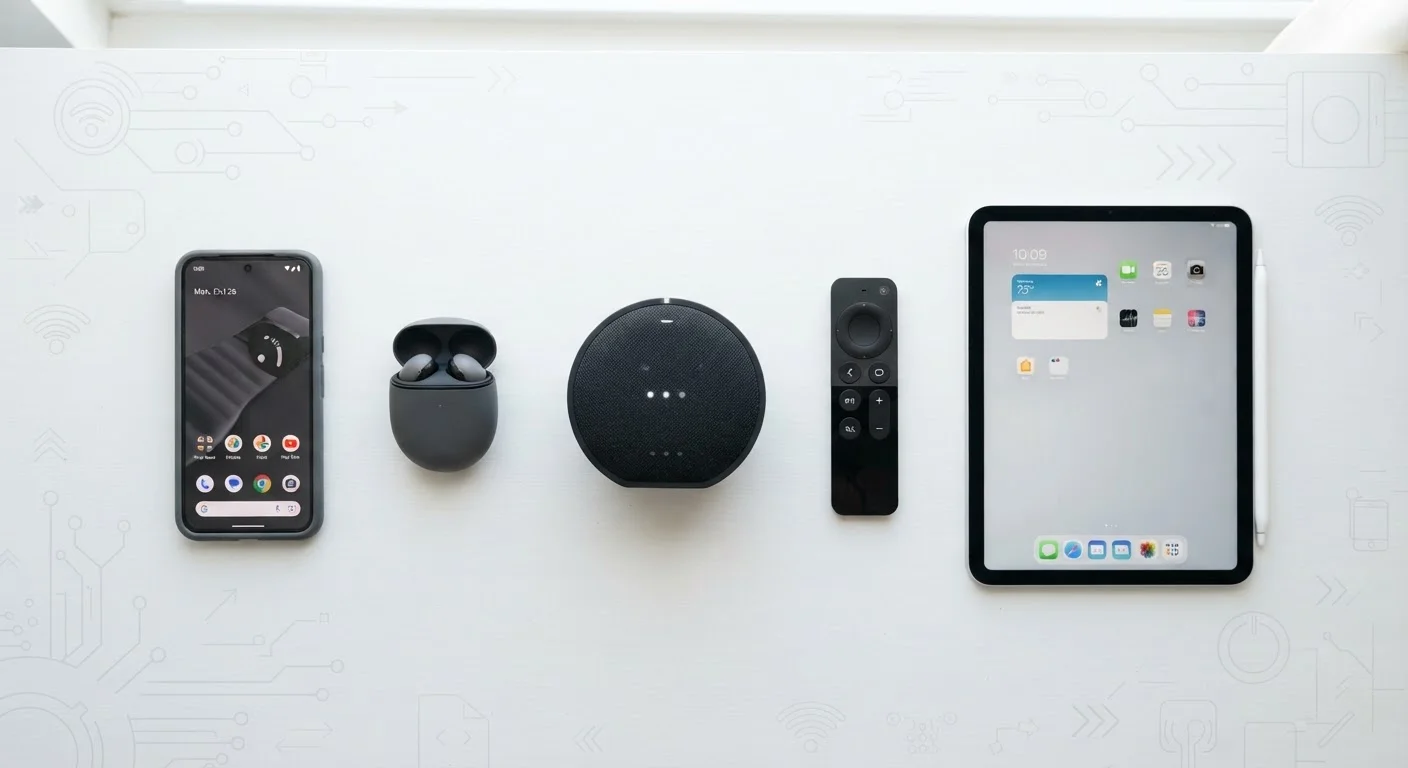
Photo credit: GadgetLite.net | All Things Tech
A plain-language reference for the most common consumer electronics terms — from refresh rate and latency to codec and form factor.
Display & Visual Terms
Every screen has a set of specs that shapes what you see — and how good it looks. Understanding display language helps you cut through marketing claims and evaluate what actually matters for your use case.
| Display brightness unit | Nits (cd/m²) |
| Common refresh rates | 60Hz, 90Hz, 120Hz, 144Hz |
| Wireless audio codec examples | AAC, aptX, LDAC, SBC |
| Water resistance rating scale | IP44 (splash-proof) to IP68 (submersion-resistant) (IEC standard 60529) |
| USB standards in common use | USB-A, USB-C, USB 3.2, Thunderbolt 4 |
| Typical consumer Wi-Fi standards | Wi-Fi 5 (802.11ac), Wi-Fi 6 (802.11ax), Wi-Fi 6E (Wi-Fi Alliance) |
- Resolution
- The total number of pixels on a screen, expressed as width × height (e.g., 1920×1080). More pixels generally means sharper images, but screen size affects perceived sharpness.
- Pixel Density (PPI)
- Pixels per inch — a measure of how tightly packed the pixels are. Higher PPI produces finer detail, especially noticeable on smaller displays like phones.
- OLED vs. LCD
- OLED (Organic Light-Emitting Diode) screens light each pixel individually, enabling true blacks. LCD (Liquid Crystal Display) uses a backlight and is typically less expensive to produce.
- Refresh Rate
- See the glossary below for a full definition. In practical terms: 60Hz suits everyday browsing; 120Hz makes scrolling and gaming feel noticeably smoother.
- Response Time
- How quickly a pixel changes color, measured in milliseconds (ms). Faster response times reduce motion blur, which matters most in gaming displays.
- Color Gamut
- The range of colors a display can reproduce. Common standards include sRGB (used for web content) and DCI-P3 (used in cinema and high-end consumer screens).
For a broader breakdown of what these figures mean in everyday purchasing decisions, see Consumer Electronics Decoded.
Refresh Rate
The number of times per second a display redraws its image, measured in hertz (Hz). Higher refresh rates — such as 90Hz or 120Hz — produce smoother motion in video and scrolling.
Latency
The delay between an input or signal being sent and its effect being received. Low latency is especially important in gaming, video calls, and wireless audio.
Codec
A codec (coder-decoder) is software or hardware that compresses and decompresses audio or video data. Common audio codecs include AAC, aptX, and LDAC.
Form Factor
The physical size, shape, and layout of a device or component. A device's form factor determines how it fits in your hand, pocket, or home setup.
IP Rating
Ingress Protection rating — a standardized scale (e.g., IP67, IP68) indicating a device's resistance to dust and water. The first digit refers to solids; the second to liquids.
nits
A unit of luminance measuring screen brightness. One nit equals one candela per square meter. Higher nit counts help screens stay visible in bright sunlight.
Bandwidth
The maximum rate at which data can be transferred over a network or connection, typically measured in megabits per second (Mbps) or gigabits per second (Gbps).
Firmware
Low-level software embedded in a device's hardware that controls its core functions. Unlike apps, firmware is rarely updated by users but is critical to device stability.
Haptics
Technology that simulates physical touch or vibration through a device. Modern smartphones and controllers use haptic feedback to give tactile responses to interactions.
HDR
High Dynamic Range — a display standard that expands the contrast between the brightest and darkest parts of an image, producing more lifelike colors and detail.
Throughput
The actual amount of data successfully transferred over a connection in a given time, often lower than the theoretical maximum bandwidth due to real-world conditions.
Thermal Throttling
A safety mechanism where a processor automatically reduces its speed to prevent overheating. It can cause noticeable slowdowns during demanding tasks on compact devices.
Connectivity, Audio & Performance Terms
Beyond the screen, consumer electronics are defined by how they connect, how they sound, and how fast they process. These terms appear across product listings, reviews, and spec sheets for everything from phones to TVs.
120Hz
High-end smartphone display refresh rate
Many flagship smartphones now ship with adaptive displays that switch between 1Hz and 120Hz to balance smoothness and battery life.
IP68
Highest common consumer water-resistance rating
IP68 is the most common top-tier rating on consumer smartphones, typically indicating resistance to submersion at defined depths per manufacturer specs.
20ms
Latency threshold considered acceptable for gaming audio
Audio engineers generally consider latency below 20 milliseconds imperceptible during real-time listening and gaming use cases.
- Bluetooth Profiles
- Standardized protocols that define what Bluetooth can do — A2DP handles audio streaming, HFP handles phone calls, and AVRCP controls media playback.
- Wi-Fi Band
- Wi-Fi operates on radio frequency bands — primarily 2.4GHz (longer range, more interference) and 5GHz (faster speeds, shorter range). Newer Wi-Fi 6E adds a 6GHz band.
- SoC (System on a Chip)
- An integrated circuit combining a processor, graphics unit, and other components into a single chip. The SoC is the central brain of most smartphones and tablets.
- RAM
- Random Access Memory — temporary storage the processor uses to run active apps. More RAM allows more apps to stay open simultaneously without slowdown.
- eMMC vs. UFS vs. NVMe
- Storage standards that differ in speed and architecture. UFS (Universal Flash Storage) and NVMe are significantly faster than older eMMC, affecting app load times and file transfers.
- ANC (Active Noise Cancellation)
- A technology that uses microphones and processing to generate anti-noise signals, reducing ambient sound. Found in headphones, earbuds, and some laptop microphones.
- Codec
- See the glossary for full details. When shopping for wireless headphones, the supported audio codec affects sound quality and latency between a source device and the headphones.
- Latency
- Critical in gaming, video calls, and wireless audio. A home networking glossary covers related network latency terms in detail.
Manufacturer specs can be misleading
Specs like 'up to X hours battery life' or 'up to X Mbps speed' represent ideal-condition maximums, not typical real-world performance. Always look for independent testing or user benchmarks alongside official figures. Context — how you actually use a device — matters as much as the number on the box.
If you use or plan to use wearables, many of these terms carry over — see the Wearable Tech Glossary for device-specific extensions of this vocabulary. For a full foundation in how modern devices work end to end, the Consumer Electronics guide is a natural next step.

Author
Electronics Editorial Team
Electronics Editorial Team is the collective byline for our editorial team and contributor network. Articles published under this byline or an editorial pen name are researched, written, and reviewed according to our editorial standards for clarity, consistency, and independence before publication.
View all articles →