
Strong Passwords vs Passphrases: Which Approach Actually Holds Up
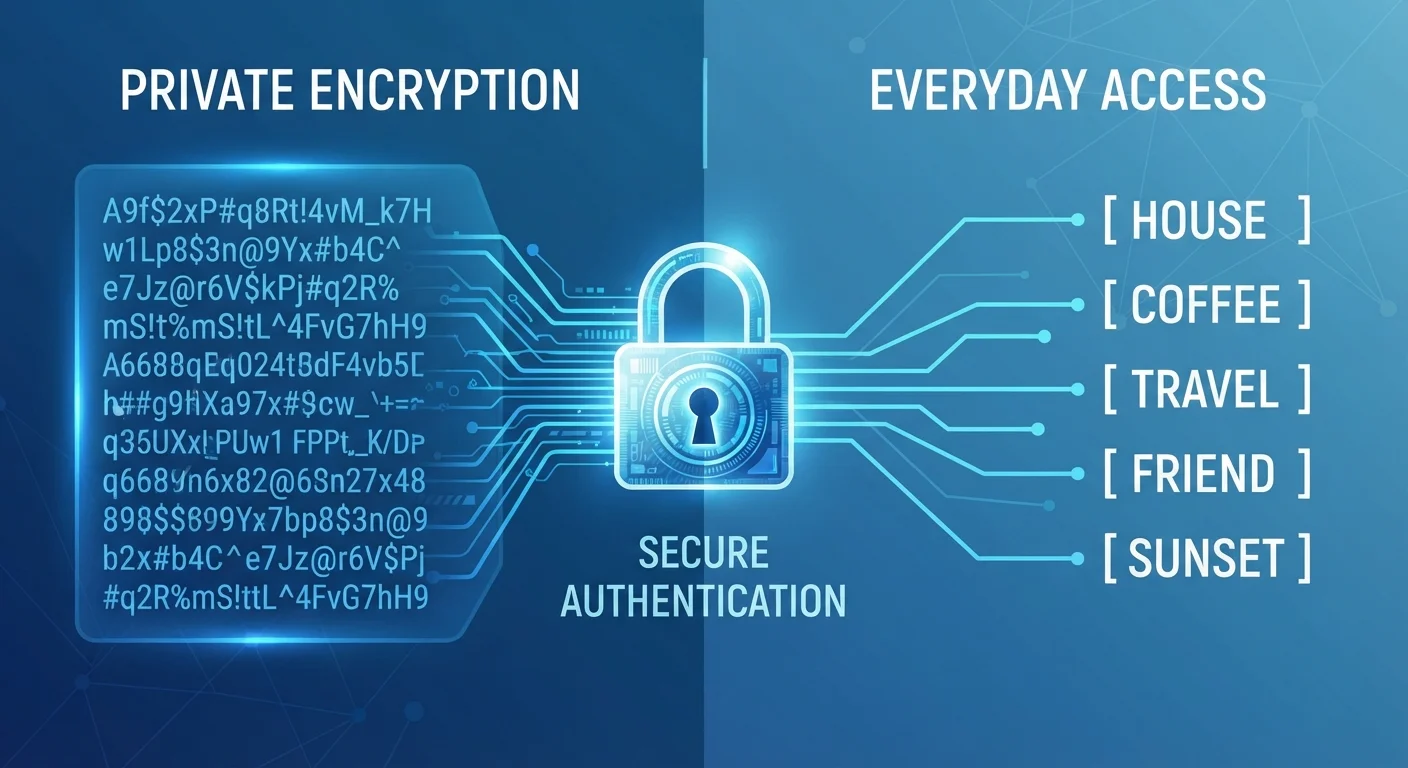
Photo credit: GadgetLite.net | All Things Tech
In this article
Traditional complex passwords and longer passphrases are both widely recommended. Here's how they compare on security, memorability, and practicality.
Key Takeaways
- Length is the single most important factor in password strength against brute-force attacks.
- Passphrases are generally easier to remember while still offering strong security when words are random.
- Traditional complex passwords work best when stored in a password manager, not memorized.
- Neither approach is foolproof without enabling two-factor authentication on important accounts.
- A randomly generated passphrase of four or more unrelated words is harder to crack than most symbol-heavy passwords.
How Each Approach Is Defined
A traditional strong password is typically a short-to-medium string - often 8 to 16 characters - that mixes uppercase letters, lowercase letters, numbers, and symbols. The idea is that complexity compensates for brevity. An example might look like R7!kQz@2mL.
A passphrase flips that logic. Instead of packing complexity into a short string, it uses length through a sequence of random, unrelated words - for example, violet-hammer-creek-fossil. The words don't need to form a sentence or make sense together; in fact, randomness is the point.
Both approaches appear across official guidance, but they succeed for different reasons and suit different situations. Understanding the mechanics helps you choose the right tool for each credential. For a deeper look at what security researchers actually measure, see what makes a password actually strong.
Security Comparison: What the Numbers Say
Password strength is ultimately about how long it would take an attacker to guess it - a measure called entropy (the mathematical unpredictability of a credential). Length contributes to entropy exponentially, while added character types contribute more modestly.
| Criterion | Strong Traditional Passwords | Passphrases |
|---|---|---|
| Typical length | 8-16 characters | 20-40+ characters (4-6 words) |
| Primary strength source | Character-type variety | Sheer length and word randomness |
| Memorability | Difficult without aids | Significantly easier to recall |
| Resistance to brute-force | Strong when truly random | Very strong at 4+ random words |
| Resistance to dictionary attacks | Depends on true randomness | Strong only when words are random |
| Best paired with | A password manager | Credentials you must memorize |
| Typing ease | Prone to errors on mobile | Easier to type correctly |
A 10-character random password using all character types has roughly 66 bits of entropy, which is strong. A four-word passphrase drawn randomly from a large word list can exceed 50 bits - and a five-word passphrase surpasses most traditional passwords. The key word is random: a passphrase built from predictable patterns like song lyrics or favorite quotes collapses quickly under a dictionary-style attack.
51%
People who reuse passwords across accounts
According to Google and Harris Poll research, roughly half of Americans reuse the same password for multiple accounts, dramatically increasing breach risk.
~90 bits
Entropy of a 6-word random passphrase
A six-word passphrase drawn randomly from a large word list (such as the EFF wordlist) yields approximately 77-90 bits of entropy, exceeding most current security benchmarks.
81%
Data breaches involving weak or stolen passwords
The Verizon Data Breach Investigations Report has consistently found that the majority of hacking-related breaches leverage weak, default, or compromised credentials.
Traditional passwords face a different vulnerability: humans are poor at creating truly random character strings. Studies consistently show people gravitate toward predictable substitutions, like replacing 'a' with '@' or 'o' with '0', patterns that automated cracking tools are specifically designed to try first.
Memorability and Everyday Practicality
Memorability is where passphrases have a clear advantage. Research in cognitive psychology consistently shows that humans remember meaningful words far more reliably than arbitrary character strings. Four unrelated words - even if chosen randomly - form a mental image more easily than Bx9#mQp!2T.
This matters most for credentials you genuinely need to memorize: your device unlock code, or the master password for a password manager. If you forget that master password, you lose access to everything it protects.
For the vast majority of your other accounts, memorability shouldn't be the deciding factor - a good password manager handles storage and autofill, letting you use long randomly generated passwords without ever typing them manually. See our Password & Account Safety hub for guidance on building that system.
A Note on 'Random' Word Selection
For a passphrase to be genuinely strong, the words must be chosen randomly - not by you brainstorming. Tools like the EFF's dice-based wordlist or a password manager's passphrase generator select words in a way your brain simply cannot replicate. If you pick words yourself, you'll unconsciously favor patterns that attackers already account for in their cracking dictionaries.
Which Should You Actually Use?
The honest answer is: use both, in the right context. Let a password manager generate and store complex random passwords for most sites. Reserve passphrases for the small set of credentials you genuinely must memorize - your manager's master password, your primary email, or your computer login.
Whatever approach you choose, layer it with two-factor authentication. Even a weak password becomes substantially harder to exploit when an attacker also needs access to your phone or authenticator app. And if you're curious where passwords are heading as a concept, passkeys vs. passwords explains the technology that may eventually replace both approaches discussed here.
The goal isn't to pick a winner - it's to match the right tool to each situation, then stop relying on memory alone for the rest.

Author
Cyber Security Editorial Team
Cyber Security Editorial Team is the collective byline for our editorial team and contributor network. Articles published under this byline or an editorial pen name are researched, written, and reviewed according to our editorial standards for clarity, consistency, and independence before publication.
View all articles →