
Gaming Platforms From Arcades to Cloud: A Timeline of How We Play
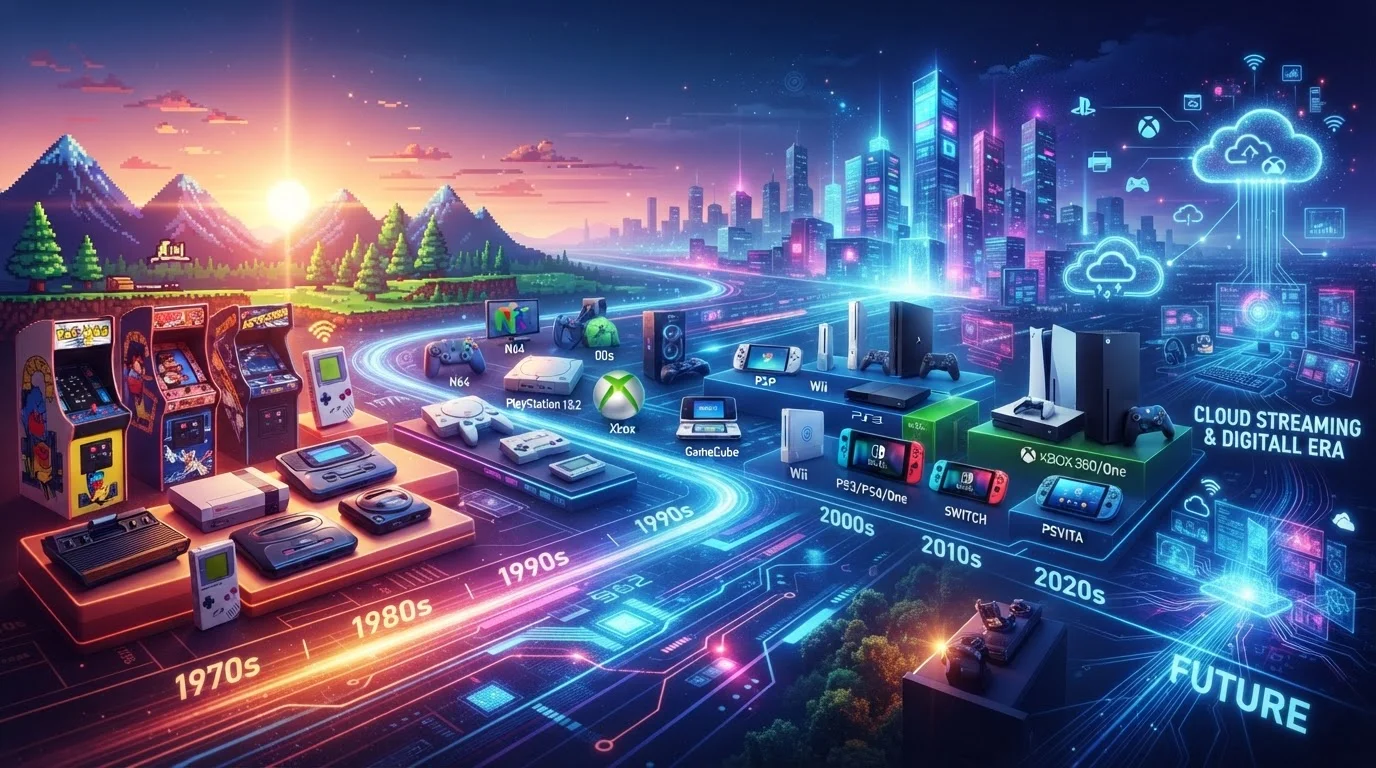
Photo credit: GadgetLite.net | All Things Tech
In this article
Trace the evolution of gaming platforms from coin-op arcades and early home consoles to today's cloud streaming services.
The Arcade Era: Where It All Started (1970s–1980s)
Before living rooms became gaming hubs, players crowded around coin-operated arcade cabinets. Titles like Pong and Space Invaders turned public spaces — pizza parlors, malls, bowling alleys — into social gaming arenas. The experience was communal and competitive by design: one quarter, one turn, one high-score board for everyone to chase.
Arcades introduced the world to gaming as a mainstream pastime, but access was limited. You had to be there, in person, with change in your pocket. That constraint would drive the next big leap.
| First commercial arcade game | Computer Space (1971) (Gaming history records) |
| First mass-market home console | Magnavox Odyssey (1972) (Industry historical records) |
| Dominant arcade peak period | Late 1970s – mid-1980s (Gaming cultural history) |
| Mobile gaming audience size | Over 3 billion players globally (Newzoo Global Games Market Report, 2023) |
| Cloud gaming dependency | Requires stable broadband; latency-sensitive |
| Platform types today | Console, PC, Mobile, Cloud, Handheld |
Home Consoles and Cartridges: Gaming Moves Indoors (1970s–2000s)
The arrival of dedicated home consoles changed everything. Early systems let players enjoy arcade-style experiences on their own televisions, making gaming a household activity rather than a public one. Over the following decades, console generations advanced rapidly — graphics improved, game libraries expanded, and iconic franchises were born.
Cartridges gave way to CD-ROMs, which offered more storage and richer soundtracks. Controllers evolved from simple joysticks to multi-button gamepads designed to handle increasingly complex games. Each console generation brought fierce platform rivalries that helped define gaming culture for millions of players. For a deeper look at how consoles compare to other platforms today, see our breakdown of consoles, PCs, and mobile gaming.
9th
Current console hardware generation
Home consoles have iterated through roughly nine major hardware generations since the early 1970s.
3B+
Global video game players
According to Newzoo's 2023 Global Games Market Report, more than three billion people play video games worldwide across all platforms.
1972
Year home console gaming began
The Magnavox Odyssey, released in 1972, is widely recognized as the first commercially available home video game console.
PC Gaming and Online Multiplayer: A Different Path
While consoles dominated living rooms, personal computers carved out their own gaming identity. PC gaming offered greater flexibility — players could modify games (called "modding"), upgrade hardware, and experiment with genres that rarely appeared on consoles, including real-time strategy and early massively multiplayer online games.
The rise of broadband internet in the early 2000s supercharged online multiplayer across all platforms, but PC gaming embraced it earliest and most deeply. Digital storefronts eventually replaced physical discs, letting players download titles instantly. This shift laid the groundwork for the subscription and streaming models that followed.
Handhelds and Mobile: Gaming Goes Everywhere
Dedicated handheld consoles proved that gaming didn't need a TV. From early devices with built-in single games to cartridge-based systems with rich libraries, handhelds created a portable gaming culture long before smartphones arrived.
When app stores launched alongside touchscreen smartphones, mobile gaming exploded to a scale no previous platform had reached. Casual puzzle games and multiplayer titles reached audiences who had never considered themselves gamers. Mobile platforms democratized access — no specialized hardware required beyond a phone most people already owned. The tradeoffs, though, are real: control schemes, screen size, and game depth differ significantly from console or PC experiences. Our guide on what separates consoles, PCs, and mobile digs into those differences clearly.
Cloud Gaming: Streaming the Future
Cloud gaming is the newest platform category, and it flips the traditional model on its head. Instead of running a game on local hardware, the processing happens on remote servers and the video is streamed to your device — similar to how you stream a movie. In theory, this means you could play a graphically demanding title on almost any screen with a decent internet connection.
The catch is real: cloud gaming is heavily dependent on low-latency internet. Input lag — the tiny delay between pressing a button and seeing a response on screen — can be noticeable if your connection isn't fast and stable. Services in this space continue to refine the technology, but cloud gaming is still maturing as a platform. Want to understand the vocabulary around these shifts? Our gaming platforms glossary explains terms like latency, ecosystem, and backward compatibility in plain language.
Whether cloud gaming eventually replaces traditional platforms or simply supplements them remains an open question — one the industry is actively debating. For a broader look at how gaming culture has shifted alongside these platforms, explore our article on how play culture evolved through the decades.
Platform
In gaming, a platform is the hardware or service on which games are played — such as a console, PC, mobile device, or cloud service. Each platform has its own library of games and ecosystem.
Cloud Gaming
A model where game processing happens on remote servers and is streamed to your device over the internet, rather than running locally on your own hardware. Performance depends heavily on your internet connection speed and latency.
Latency
The delay between a player's input (pressing a button) and the game responding on screen. Low latency is critical for responsive gameplay, especially in cloud gaming.
Ecosystem
The interconnected set of hardware, software, services, and digital purchases tied to a specific gaming platform. Moving between ecosystems often means leaving behind games and purchases you've accumulated.
Backward Compatibility
A console's ability to play games made for an older version of that same platform. Not all consoles support it, and coverage varies even when they do.

Author
Gaming Editorial Team
Gaming Editorial Team is the collective byline for our editorial team and contributor network. Articles published under this byline or an editorial pen name are researched, written, and reviewed according to our editorial standards for clarity, consistency, and independence before publication.
View all articles →